Tuesday, 23 July 2013

Caraca Natural Reserve

The other half of our time in Minas Gerais state was spent at the monastery in the private nature reserve at caraca.

The monastery was built in 1773 and has a educational past as it was used a boarding school for boys where past Brazilian presidents once studied, but today its emphasis is on environmental education. There is a wealth of history about the site found in the ruin of the old school where an interesting museum and library are found.


The protected area is about 43 square miles and is a natural ecotone where the two habitats of cerrado and Atlantic rainforest meet. The reserve is also within the 1 billion year old Serra Do Mar mountain range which stretches along the eastern edge of Brazil and home to many endemics. The monastery is among the mountains and at an altitude of 1,250 m.

The biggest highlight of the reserve is the maned wolf. In 1982 the priests noticed regular damage to the rubbish bins and began to leave out food to stop animals from causing a mess. This then lead to one of the priests leaving a tray of chicken out to watch the wolves coming to feed, and it has now become a nightly ritual. Over the 2 nights we spent on the patio outside 2 different wolves came to feed on the chicken sometimes less than a meter away from us. They give onlookers a good look up and down before grabbing a mouth-full and disappearing back into the darkness.


Maned wolves


A short trail leading through Atlantic forest called the Tanque Grande trail was the trail we did most as this is the best location for seeing the masked titi monkey. In the mornings they are vocalising to other troops and the sound can travel a long distance making them easier to locate. We found 3 different troops showing extremely well.
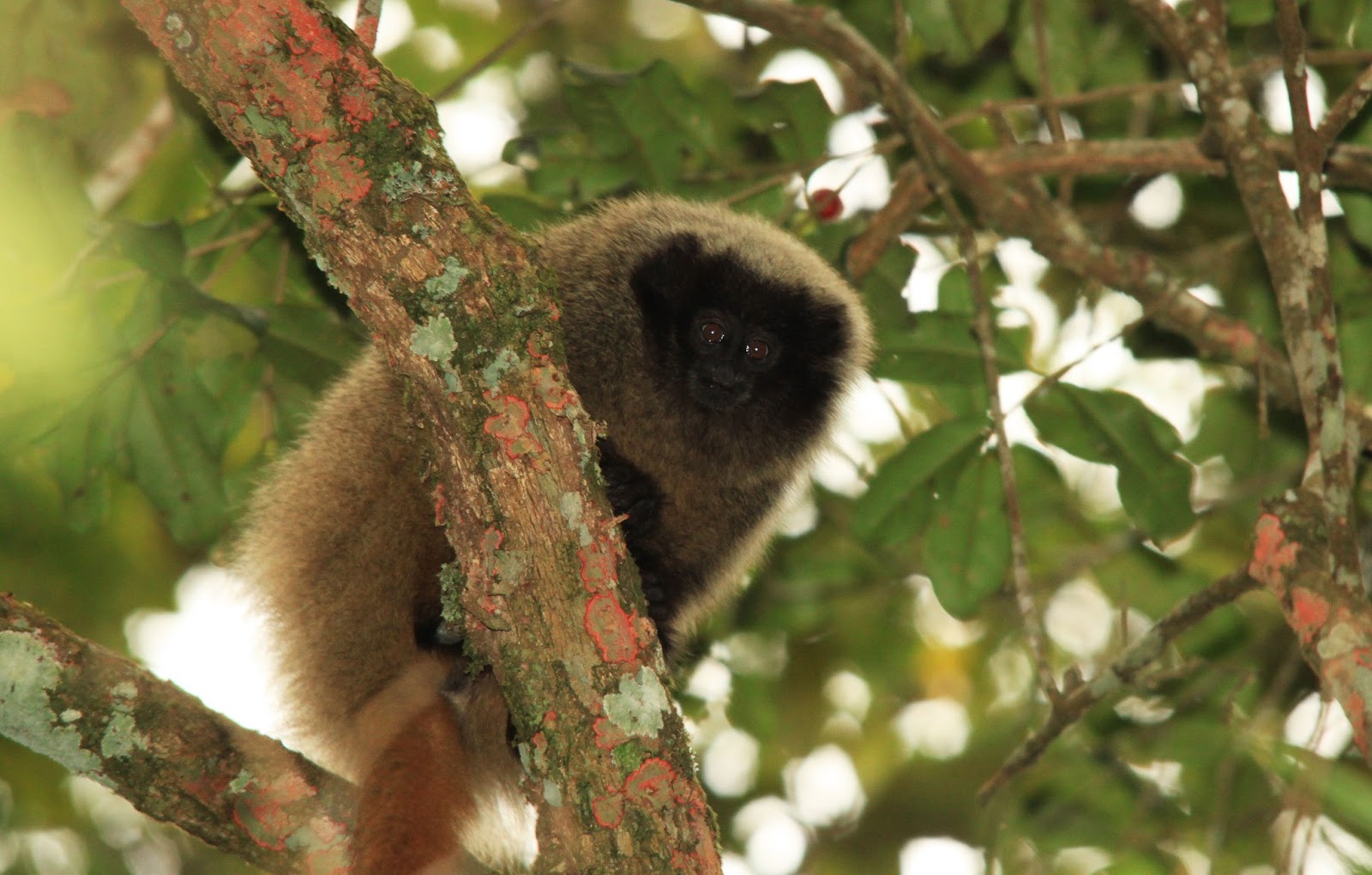

Masked titi monkey


Caraca has a good population of the guianan squirrel which we saw quite easily on the trails and around the car park.


Guianan squirrel


We also decided to try a few night drives but because the forest is so close to the road it is very difficult to spotlight, but we did see crab-eating fox, Brazilian tapir and a juvenile Brazilian porcupine at night.

Crab-eating fox

Brazilian porcupine

Brazilian tapir


The birdlife at Caraca is also very exciting as there are many range-restricted species present. In the forest around Tanque Grande we found highlights including: white-bibbed antbird, pin-tailed and blue manakins, serra-do mar tyrant manakin, rufous gnateater, white-rimmed warbler, golden-crowned warbler, white-bellied warbler, crested oropendola, chestnut-headed tanager, gilt-edged tanager, hepatic tanager, swallow tanager, yellow-legged thrush, surucua trogon, lineated woodpecker and green-winged saltator.

In the higher areas and cerrado habitats we found hyacinth visorbearer, sapphire-spangled emerald, scaly headed parrot, highland elenia, mottle-cheeked tyrannulet, hangnest tody tyrant, velvety black tyrant, sooty-fronted spinetail, pale-throated pampa finch and around the vegetable garden and pond slaty breasted wood-rail, blackish rail and dusky legged guan.

Serra da Canastra National Park

I have been away from Regua for a short break to travel around Brazil with my partner Lorna.

I organised an itinerary with the help of Jan at Brazil Nature Tours and I can highly recommend him and the company to others travelling around Brazil, particularly with complicated itineraries.

The first portion of our trip was in Minas Gerais state (4th largest Brazilian state) and our Guide was Fred Tavares, who cannot be recommended highly enough, not just for this area, but for any region of the country and we had a very enjoyable time with him.

Our first destination was the Parque Nacional da Serra da Canastra, which protects 715 Square km of cerrado and gallery forest. Cerrado is a tropical savannah found across 20% of Brazil and is the main biome of the eastern plateau. The cerrado is little known in comparison to other major ecosystems in Brazil, but is surprisingly important as it is home a third of all the species in the country, but is severely threatened by destruction for Soya plantations.


We spent two full days exploring the park from our base in San Rouqe de Minas, where we stayed at the Chapado do Canastra Hotel.

On the first day we explored the highland cerrado, rock fields and open grasslands and the second we spent time in the lower farmlands, gallery forest and river valley.

The mammal list for the park is very impressive but it is particularly important for cerrado specialists. Canastra is famous for being the best place (probably in the world) to see Giant anteater which can be found by scanning the grasslands and looking for an odd shaped rock that will eventually move. The first one I spotted was maybe 3/4 of a mile away and stood out only for being the only dark shape in an area devoid of rocks. Once we located an anteater we approached them downwind, sometimes to within 10 meters. It is possible to get so close because they have very poor senses other than smell and have their head down for long periods. We saw a total of 5 different anteaters in the 2 days inside the park, but we stopped looking for them after that so could of maybe seen more.

Giant anteater

The other two mammal targets were pampas deer and maned wolf. The pampas deer are reasonably abundant in the cerrado but quite hard to spot, however we saw 5 during our time including some close views in an area of recently burnt grass which they favour for the fresh growth.

Pampas deer

Maned wolf is definitely the hardest of the three mammals to find but we found one on the first afternoon whilst walking closer to an anteater. The views are often distant, but the population in Canastra is good and as a result they are closely monitored by researchers, including the one we saw which was radio-collared.
Maned wolf
 

Around the town of Sao Roque de Minas and in the gallery forests around the river there is a healthy population of the black-tufted ear marmoset, which sometimes visit the gardens of the town including our hotel, we found a group of 4 on our last day in a garden early in the morning.

Black-tufted ear marmoset


In the lower half of the park the habitat changes to gallery forest and the fauna and flora is quite different. The Rio San Fransico runs through this section and it is well preserved to maintain habitat for the critically endangered Brazilian merganser. Canastra is of vital importance for this species as it holds almost the entire world population of just over 200 pairs. However they are a very difficult bird to see and their habitat (clear fast flowing water with gallery forest) is being well protected to keep disturbance to a minimum. Fred helped monitor the mergansers before and knew their habits very well which helped us have great views of a pair on several occasions.

Casca d' Anta waterfall.


The bird highlights in the cerrado included
Gray-backed tachuri, long-tailed tyrant, cock-tailed tyrant, crested black tyrant, campo flicker, wedge-tailed grass finch, white-eared puffbird, toco toucan, red-legged seriema, greater rhea, spotted nothura, red-winged tinamou, bat falcon, aplomado falcon, amercian kestrel, white-rumped tanager, crested becard, sooty tyrannulet, hooded siskin, chopi blackbird, white-rumped monjita, yellow-rumped marsh bird, yellow-bellied seedeater, stripe-tailed yellow finch, blue finch, plumbeous seedeater, pileated finch, firewood gatherer, pale-breasted spinetail, black-throated saltator, tawny-headed swallow, great dusky swift and band and sickle winged nightjars.

The bird highlights in the lower part of the park included:
Brazilian merganser, helmeted manakin, cliff flycatcher, green-winged saltator, guira tanager, burnished buff tanager, sayaca tanager, crested oropendola, palm tanager, short-crested flycatcher, blue dancis, highland eleania, bananquit, long-tailed tyrant, streamer tailed tyrant, blue-black grassquit, plush-crested jay, king vulture, golden-capped parakeet, scaly-headed parrot, stripe-breasted starthroat, white-vented violetear, fork-tailed woodnymph, glittering-bellied emerald and swallow-tailed hummingbird.

Brazilian mergansers

Stripe-breasted starthroat


Friday, 14 June 2013

Camera Trap Results!

While I have been at REGUA I have been using my camera trap to monitor the mammal species using the reserve and hopefully help to plan a stake out.

The first location I set the camera was overlooking a patch of forest Steve had baited with fruits. This location proved to be very fruitful!

I recorded over 100 videos of 3 different pacas, including a juvenile, as well as black rat, large-headed rice rat and a third so far unidentified rodent species plus unidentified fruit bats and even an owl swooping down on the rodents.

The second location that I chose to place the camera was overlooking a tree that was being used by a female puma as a scent marking tree. Unfortunately she appears to have left the area currently and is probably completing a routine check up on her terrorist that can be up to 1000 km2. Talking the guides, Steve and officials in the state park it appears pumas are well distributed in the area, but are at a low density so their home ranges are likely to be large as there is less competition.

However since the departure of the female, several species of smaller carnivore have decided to use the tree to scent mark as well. Each species appears to smell the others and still wants to leave their mark.

I have captured 2 different ocelots (you can see from the thickness of tail and markings), tayra, crab-eating fox and south american coati all using the tree. (Below is a Tayra)
 
For more videos are images please visit:
http://www.flickr.com/photos/ian_loyd_wildlife/sets/72157634100644789/http://www.flickr.com/photos/ian_loyd_wildlife/sets/72157633380184746/
http://www.flickr.com/photos/ian_loyd_wildlife/sets/72157634100644789/

Thursday, 13 June 2013

Mammals!

When I arrived at REGUA I met Steve Morgan, who is a well known fellow mammal watcher from the UK. He had also heard about REGUA at the Birdfair last year and decided to volunteer to undertake a mammal survey of the reserve. He spent 8 weeks using camera traps, setting small mammal traps, baiting and looking for tracks and signs. He had a great time and established the presence of a reasonable diversity of mammal fauna, but it was worrying that the numbers of some species were still quite low.

The reasons for this are that the remaining forest near to REGUA are not completely joined up and thus creating a habitat barrier to many species. The other reason being the forests around REGUA have a long history of severe hunting by locals and many species are close to local extinction level in some areas. This means there is no population pool for many species to recolonise newly created and protected forest.

Despite this the populations of many species are recovering and it is great to see that top predators such as puma are returning.

I have so far seen the following mammals whilst searching the reserve:
Brown howler monkey, South-eastern common opossum, large-headed rice rat, capybara, paca, brown-throated three-toed sloth, Guianan squirrel, greater fishing bat, fringe-lipped bat, greater spear-nosed bat and several unidentified bats as well as the introduced white-tufted ear marmoset and black rat.


The most exciting encounter was trying to see the paca, which is a very elusive forest species of agouti that has been coming an area of forest that Steve had been baiting with fruit. We could see from our camera traps that they were visiting every night so we organised a stake out.

We sat in the forest on a very steep slope well into the evening in complete silence as we knew they would be very skittish to any noise or movement. It was pitch black and all we could hear were rustlings from small creatures nearby, plus numerous bats flying over and sometimes hitting us. Eventually we could hear a noise that sounded just right and Steve carefully covered the torch enough for us to see but not scare the paca away. We only had about 10 seconds viewing but the views of it, only 3 meters away was a fantastic experience!

Shrike-like cotinga

I was fortunate to see a pair catching caterpillars from the undersides of a branch on the Sao Jose trail one morning and have also had sightings on the green and red trails further up in the forest. Like so many of the species in the Atlantic Rainforest it has a very limited distribution and sites to see them are very few. The reliability of the birds at Regua, may make it the best site in the world to see this beautiful species.


One of the reasons that there are so many endemics in the Atlantic Rainforest is because it has been isolated from the only other area of similar habitat (The Amazon basin) for so long, that species have evolved separately. However many of the endemics now are isolated to just a small area of the forest because it has become so fragmented.

Some scientists have proposed that the Atlantic Rainforest is actually more bio-diverse than many parts of the Amazon because of its diverse range of topography, altitude and wide distribution along the South American coastline that passes through different climatic regions.

Red Trail

On Saturday 31st May and Thursday I joined Adeli and a guest at the Guapi Assu lodge on a trip to the highest trail in the Reserve, the red trail. It reaches a higher altitude than many of the other trails through the area. Near the top, the forest changes character from tall secondary growth into bamboo thickets and eventually elfin woodland. The elfin woodland is a mixture of stunted trees, palms and dwarf ferns with an abundance of lichens and mosses growing on the floor and there is an increase in miniature bromeliads and orchids.


This different habitat offers a different food and habitat source to many specialist birds such white-bearded antshrike, black-billed scythebill white-bibbed antbird, greenish Schiffornis, grey-capped tyrannulet, golden crowned warbler and ferrugionous antwren. All of which we saw very well.

The trail can be very steep in places and that makes looking up in the canopy very difficult whilst moving but we managed to see an extensive range of mature forest species such as rufous-breasted leaftosser, ochre-breasted, black-capped and white-eyed foliage gleaners, pale-browed treehunter, sharpbill, white-throated, planalto, olivaceous, scaled and thrush-like woodcreepers, star-throated antwrens, red-necked, green headed, brassy-breasted, white-bellied, brown, red-crowned ant, flame-crested, olive-green and black-goggled tanagers, black-throated grosbeak and rufous-capped anthrush.

Near the top of the trail on Thursday I came across two frog species, both requiring full identification still, but one was particularly spectacular as I immediately noticed it had obvious horns on it's head.

I am currently building a showcase of amphibian and reptile pictures that when I get a chance will thoroughly go through to identify them. There is very little help on the Internet to help with identification.


The wetlands at REGUA

I have been at REGUA (Reserva Ecológica de Guapiaçu) for 2 weeks now and have settled in well and have been busy helping to show visitors to the Guapi Assu Bird Lodge the birds and wildlife around the reserve.


The main habitat that I am spending most time in is the restored wetlands close to the conservation centre. The habitat is mostly open lakes with islands, causeways and reed fringed edges to create a suitable nichies for a mix of species.

The bird life around these wetlands is fantastic and a great place to introduce yourself to many of the South American bird families.

Some of the regular species include; white-faced whistling duck, Muscovy duck, Brazilian teal, purple gallinule, capped, striated, cocoi and rufescent tiger herons, great and snowy egrets, wattled jacanas, white-headed marsh and masked water tyrants, wing-banded horneros, social flycatchers, smooth-billed and greater anis, creamy-bellied thrush and tropical kingbird.

I am starting to learn good spots to find certain species such as yellow-lored and common tody flycatchers, chestnut backed antshrike, slaty-breasted wood rail and rufous-sided crake.

There is also an impressive cattle egret roost on the main lake every evening with around 400 birds jostling for the best positions amongst the branches of the islands.

There is a group of around 30 capybara regularly around the wetland and there are currently several youngsters amongst the group. Broad-snouted caiman are more difficult to find around the wetland but I usually see at least 2 every visit. This species was new for me as it only occurs in Eastern and southern south America. It can grow to around 3 meters but most of the individuals here are about 1-2 meters long. 

I have started a special set of pictures on Flicker for my time at REGUA.
http://www.flickr.com/photos/ian_loyd_wildlife/sets/72157634100644789/

Or alternatively scroll through the various Overseas albums to see some new pictures.