Thursday, 8 May 2014

Decoy Heath and Hartslock

I had been keen to get back to Decoy Heath BBOWT Reserve where I used to monitor the reptile populations to see how the site was looking and see what reptiles would be out. The weather was perfect for basking on the day, although the temperature could have been higher.

A walk around the usual route yielded at least 10 male slow worm but only 1 female which is what I have come expect this early in the season. I even found one basking in the open which is actually very unusual as they rarely expose their entire body in the open preferring to remain hidden or under ground.

(Slow worm m)

I was slightly worried by the lack of adders which I was hoping to find but I did hear a couple slither away that were likely hiding under dense gorse. Eventually I found one basking in heather in a favourite location.


(Adder)

Later in the day I made my way to another BBOWT Reserve, famous for its chalk grassland communities; Hartslock.


(River Thames, from Hartslock)


I was particularly hoping to find pasqueflower (Pusatilla,vulgaris), a stunning flower that only blooms around Easter. After a little search I found a small colony, although I was hoping to find slightly more they were such vivid colours that the 10 or so were good enough! This species is very much restricted to calcareous grasslands and only occurs at 19 sites in England.

(Pasqueflower)

(Early purple orchid)

(Chalk milkwort)

Dawlish Warren

I have a made a couple of visits to Dawlish Warren recently mainly looking for birds, the first visit involving mostly lingering over-wintering waders and wildfowl out in the Exe estuary including a flock of brent geese that included an individual of the pale-bellied race.


(Pale-bellied brent goose)

Later on I saw more newly arrived migrants including a mixture of common warblers, sandwich terns, several flocks of whimbrel, common scoter and buzzard coming off the sea.

I also timed my visit to see the nationally rare sand crocus which usually blooms in the first two weeks of April. The sand crocus (Romulea columnae) which is known locally as the warren crocus is only known to occur at one other site in Britain in Cornwall. It is a native species right on the very northern edge of its range. The mild winters, warm summer climate, poor nutrient levels and freely draining soil at the warren make it suitable outpost for a small population of the species to thrive. At 7mm in diameter they are pretty tiny and surprisingly easy to miss, but still bigger than some of the other specialities of the site I found.


(Sand crocus)

There was plenty of early-forget-me-not in flower too which was nice to see and with some advice from the warden I finally tracked down petalwort. Petalwort (Petalophyllum ralfslii) is a small green liverwort found in damp hollows within sand dune slacks and is only known from 26 sites in the UK. It was a real hands and kness job to find one, but one you find it is was surprisingly conspicuous but was still restricted to just  maybe 2 or 3 square metres within the dune slacks that I could find. Very much a niche existence!


(Early forget-me-not)


(Petalwort)

On the way home from work with my colleague a couple of days later, we had an osprey fly low directly over the car, which was a nice surprise. (no pictures unfortunately) We suspect it was following the River Dart to head north initially.

Wednesday, 7 May 2014

Yarner Wood

I recently spent a very enjoyable day exploring Yarner Wood NNR near Bovey Tracey on the eastern edge of Dartmoor. The wood is beautiful with gnarled sessile and English oak trees covered in moss, mixed with hazel and rowan completed with an understory of holly and a ground layer of bilberry.


I was particularly hoping to find pied flycatchers and lesser spotted woodpecker. I was successful in finding 5 male stunning and very vocal pied flycatcher throughout the wood, but there was no sight nor sound of the woodpecker unfortunately. I was slightly too early in the month for the other denizens of this habitat such as wood warbler and tree pipit, but did see a nice range of other woodland species and common butterflies.


(pied flycatchers)
 
Wood ant nest (Formica sp)
 
I also visited Hembury woods again a great example western oakwoods on the southern edge of Dartmoor earlier in the month to see the spectacle of hundreds of wild daffodils blooming in the oak woods there. I have never seen wild daffodil in these numbers before, there was a carpet of yellow in many places.

(River Dart)

(Wild daffodils)

Sunday, 5 January 2014

Divers in Brixham Harbour.

With only a short window of time, I took the opportunity to do some birding around Brixham harbour today.

A white-billed diver has been present in the harbour and the general Torbay area since Christmas.

Although there were a few sightings of the bird in the early morning, it must have moved further offshore later on as I never found it.

There was however an impressive array of other species in the area. Of particular interest was at least 10 great northern divers spread around the coast and a few were feeding in the harbour. Being mainly arctic breeders the main chance to see them in Britain is during the winter where they are most abundant in the northern isles of Scotland and the west coast of Ireland. There is an increasing number wintering in the Torbay area and they regularly overwinter in the harbour due to easy fishing.


(Great northern divers)
 

On average there has been a 39% increase in wintering numbers of great northern divers in the UK since the 1981-1984 BTO bird atlas.

I also noted at least 4 black-throated divers close inshore and one bird in the harbour itself.


(Black-throated diver)
 

There was several common guillemots feeding in the area including this individual in almost full summer plumage, which is a very unusual phenomena.


(Common guillemot)
 

Another rare sighting was that of a black guillemot (in full winter plumage) that was  feeding in the harbour.

(Black guillemot)

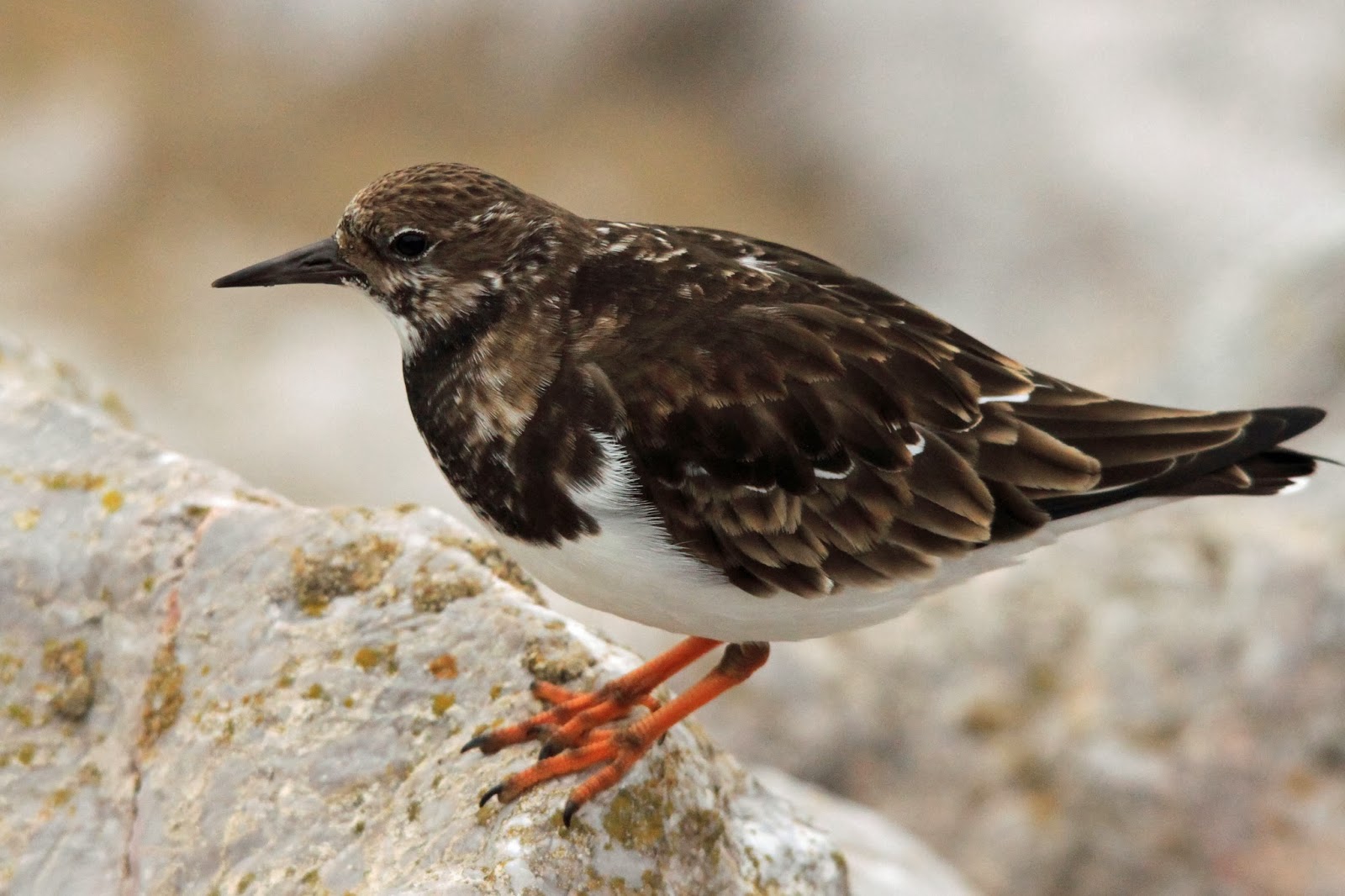
I took a walk along the breakwater were there was plenty of turnstones feeding along the shoreline and even at pedestrians feet where there was scraps of fisherman's bait leftover. Rock pipits, gannets and the usual gulls were also present. A little further on and I noticed a pale gull amongst the herring gulls soaring in the harbour. Sure enough this was the 1st winter Iceland gull that has been in the area and it even showed off by flying right overhead beautifully demonstrating its all "white wing tips"


(Iceland Gull)
 

Confusingly Iceland gulls do not actually breed in Iceland, although they do overwinter there, they actually nest in Northern Canada and Greenland and are only rare vagrants to North West Europe in the winter.


After some searching I also found the red-necked grebe that has been seen on and off in the area. By this point the rain had become very persistent so I decided to head home.

(Red-necked grebe) 
(Cormorant)

Monday, 30 December 2013

Purple Sandpipers

I recently went to Brixham Harbour on the Western side of Torbay.

The wind was extremely strong but it created a wild atmosphere and it was great watching the gulls and gannets battling against the wind.

The breakwater that creates the harbour is a favoured wintering site for rocky shore specialist birds such as purple sandpiper, turnstone and rock pipit.

 
(Great Black-backed gull)


I counted 23 purple sandpipers and at least 15 turnstones along the shoreline of the breakwater and several rock pipits were nervously feeding in the same area.


(Purple sandpipers and turnstone)
 

Interestingly 2 turnstones and a purple sandpiper were feeding from a fishermen's leftover bait on the concrete walkway of the breakwater, this is behaviour I have seen in turnstones before, but not purple sandpipers.


(Turnstones and purple sandpiper)

The harbour itself is apparently a regular haunt of grey seals that like to hunt the fish that frequent the calmer waters.

I saw a huge bull grey seal at dusk hunting along the shoreline although he never remained above water long enough for a picture. A fantastic sight!


Tuesday, 3 December 2013

Brazil Trip Report

I have now published a trip report for my summer spent in Brazil on my website.

http://ianloydwildlife.co.uk/section668137.html (A summer in Brazil) Or direct on sky driver: http://sdrv.ms/1bGKRLU

Invertebrate species lists will hopefully soon be updated.

Hopefully the report will prove to be useful to those interested in visiting some of the areas and maybe encourage people to visit Brazil!

I have not gone into detail on personal highlights and experiences because there would be too many to list. However the time I spent at REGUA particularly provided me with some outstanding wildlife and people experiences. It was a true pleasure to spend time and have stimulating, funny and memorable conversations with so many like minded conservationists, birders, volunteers, locals and guides.

The wildlife highlights range from moments of pure heaven seeing unusual and rare behaviour and species, to catching some great camera trap footage and a few slightly scary encounters with a puma!

As always I will be happy to help give advice to anyone interested in specific detail, or please get in touch if you have any suggestions or comments.

Enjoy.


Saturday, 30 November 2013

New home in Devon

I have recently moved to Totnes in southern Devon to work for the wildlife tour company Reef and Rainforest Tours.

I have recently been out exploring my local natural attractions including the beautiful Dartmoor National Park and South Hams rugged coastlines.


(Brixham Head, Paignton)
 
 
(Gannet, Brixham Head)
 
 
(Dartmoor National Park)
 
One of the birding highlights recently was at Clennon Valley, in Paignton. There is a long staying yellow-browed warbler favouring a patch of willow and sycamore along a small stream near to Broadsands area of Paignton. On my second visit to the site I had some great views of the bird, but it rarely perched long enough to obtain a picture.


(Yellow-browed warbler)
 
The majority of the yellow-browed warbler population over-winters in southern Asia. However each year there are increasing numbers of this tiny warbler arriving on the eastern coast of the United Kingdom and other areas of Europe and even north Africa. There are now many theories as to why these birds are migrating so far to the west of their normal (known) wintering range. These include; reverse migration, and random dispersal. The most recent proposal however is that a part of the population may be discovering (colonising) a new wintering range in the west. Yellow-browed warblers are active feeders and seek out insect rich habitat when they arrive in the UK and are associated with non native sycamore trees because of the abundance of autumn insects these trees offer.
 
 
I frequently observed the yellow-browed warbler at Clennon valley feeding by hovering below a sycamore leaf to probably pick greenfly larvae from underneath the leaf. The same patch of woodland was also used by 2 chiffchaffs and several goldcrests that were feeding in the same way. A Green woodpecker, jays and several buzzards entertained me while searching for the warbler.
 
 
(Green woodpecker)
 
I later popped into the Broadsands car park for a look at the cirl buntings that overwinter in that area but only managed distant views. I finished the day at the weir in Totnes where there was a kingfisher actively hunting the main pool below the weir and a mobile pair of goosander too. As the light faded I caught a glimpse of what was probably an otter swimming downstream towards Totnes, but because of the light and overall poor view it prevented a 100% certainty to the identification of the animal (it could have been an American mink). I am really looking forward to finding more wildlife in this this beautiful county.